
Most homeowners spend about $9,000 to $18,000 to replace a roof on a typical single-family home, and the full range runs from roughly $5,800 for a small, simple roof to $46,000 or more for large or premium ones (per NerdWallet and Angi and GAF data). Your price depends less on any national average and more on five factors: roof size, material, pitch and complexity, how many old layers must be removed, and the condition of the decking underneath.
Two homes on the same street can get very different quotes because of those details, which is why the only number worth planning around is one based on your own roof inspection.
Price is only half the picture. What you pay out of pocket can drop sharply if hail or wind caused the damage and your policy covers it, and part of the cost often comes back when you sell.
This guide covers what drives your quote, when a repair may be the smarter spend, and how insurance or resale value can offset the expense. If you are still choosing a material, compare roofing materials in our full guide first.
There is no single average cost for a new roof that fits your home, because the factors that determine the price vary from one roof to the next. Online averages blend tiny ranch homes with large, steep, multi-story roofs and every material from basic shingles to slate. Local labor rates, permit requirements, and material availability shift the number again, so a figure that works in one market can be far off in another.
The low end of any published range usually reflects a small, simple roof with asphalt shingles and a single layer to remove. The high end reflects large homes, steep or complex roof lines, and premium materials such as slate or tile. Hidden conditions, such as soft decking or poor ventilation, only become apparent when a professional inspects the roof.
A credible estimate should break the total into materials, labor, tear-off and disposal, and any decking or flashing work. When you compare roof replacement services, ask each contractor for that breakdown so you can compare line items rather than bottom lines.
Roofers measure and price by the “square,” which equals 100 square feet of roof surface. A roof described as 20 squares covers about 2,000 square feet. Your roof surface is larger than your home’s floor area because of slope and overhangs, so the measurement has to come from the roof itself, not the floor plan.
The per-square rate is not fixed. These factors decide where your roof lands.
| Factor | What it means | Impact on cost |
|---|---|---|
| Roof surface area | Total squares of material and labor needed | High |
| Material | Asphalt, metal, tile, slate, wood, or synthetic | High |
| Pitch and complexity | Steep slopes, valleys, dormers, skylights, chimneys | Medium to high |
| Layers to tear off | One layer versus two or more, plus disposal | Medium |
| Decking repair | Replacing soft or rotted wood found during tear-off | Low to high, depending on the extent |
| Ventilation and flashing | New vents, drip edge, and flashing details | Low to medium |
| Permits and access | Local permit rules, stories, and how easily crews can load the roof | Low to medium |
A free inspection measures your roof, checks the decking and ventilation, and turns these factors into a written estimate from your local Storm Guard team.
Because roofers price by the square, your total scales with roof size. These ranges span typical asphalt-to-premium installs; your material and roof complexity move you within them.
| Roof size | Typical installed cost |
|---|---|
| 1,000 sq ft (10 squares) | $4,000 – $11,000 |
| 1,500 sq ft (15 squares) | $6,000 – $16,500 |
| 2,000 sq ft (20 squares) | $8,000 – $22,000 |
| 2,500 sq ft (25 squares) | $10,000 – $27,500 |
| 3,000 sq ft (30 squares) | $12,000 – $33,000 |
Material is the single biggest swing factor in roof pricing. Asphalt shingles remain the most affordable common option, while slate, tile, and metal cost more upfront but last far longer.
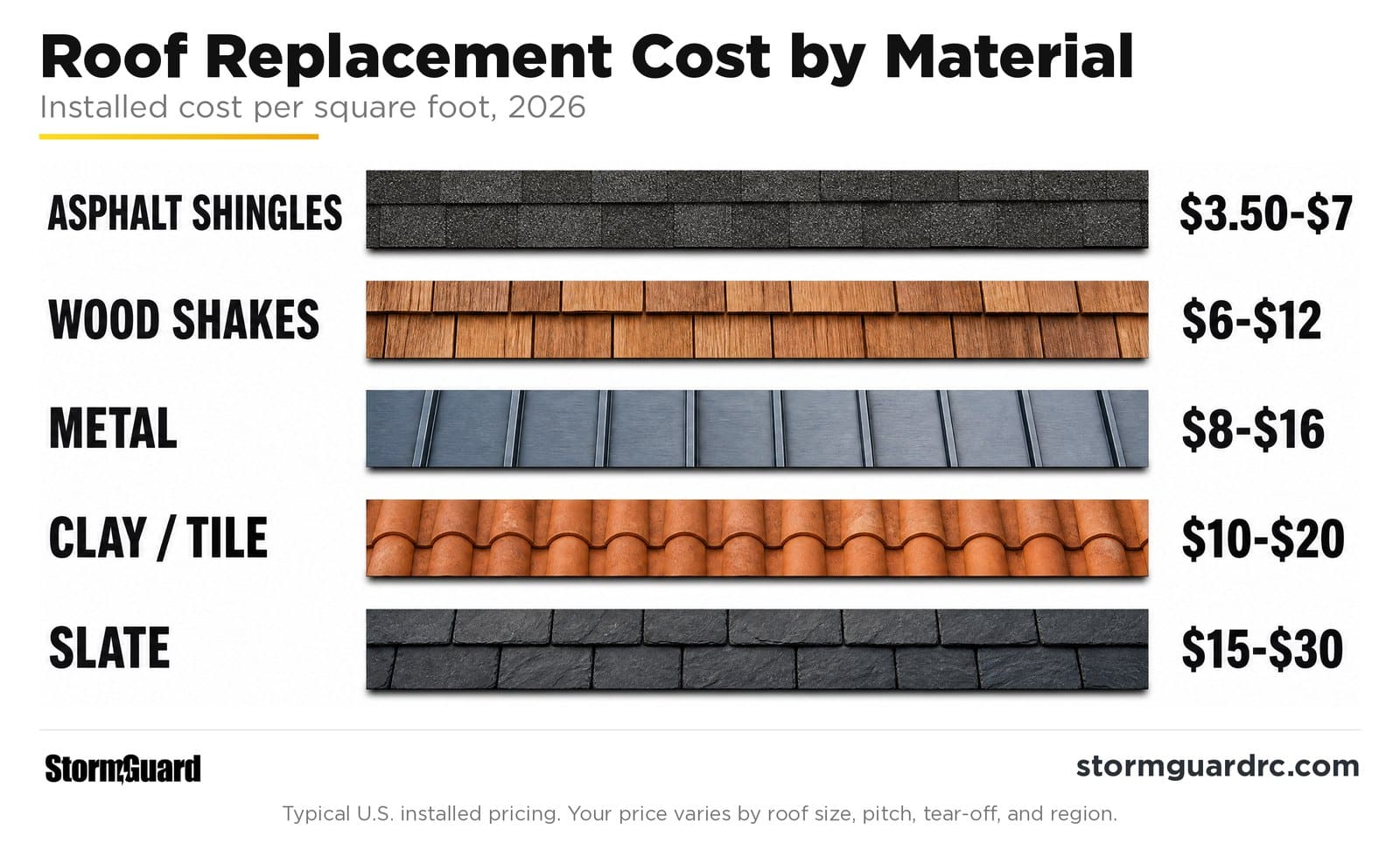
The table below pairs each material’s relative cost impact with InterNACHI’s life expectancy chart so you can weigh price against years of service.
| Material | Installed cost ($/sq ft) | Typical lifespan (InterNACHI) |
|---|---|---|
| Asphalt shingles | $3.50 – $7 | 20 years (3-tab) to ~30 years (architectural) |
| Synthetic shingles | $5 – $12 | Varies by product |
| Metal shingles or shakes | $8 – $16 | 40 to 80 years |
| Wood shingles or shakes | $6 – $12 | ~25 years |
| Clay or concrete tile | $10 – $20 | 100+ years |
| Slate | $15 – $30 | 60 to 150 years |
Upfront price and cost per year of service tell different stories. A cheaper roof replaced twice can cost more over 50 years than a pricier roof installed once, so match the material to how long you plan to own the home.
Asphalt shingles carry the lowest installed cost of any common option. Architectural shingles cost a little more than basic 3-tab shingles but last longer, about 30 years versus 20 on InterNACHI’s chart, and Home Innovation Research Labs reports that most builders now use them on new homes.
Metal costs several times more than asphalt upfront, and panel style, gauge, and finish all move the price. Its 40- to 80-year lifespan means many homeowners pay for only one metal roof in the time they would buy two or three asphalt roofs.
Wood shingles and shakes offer a natural, high-end look at a mid-to-upper price, roughly $6 to $12 per square foot installed, and last about 25 years on InterNACHI’s chart. They need regular maintenance, and some areas limit them for fire reasons, so check local codes before choosing wood.
Clay and concrete tile sit at the high end of the market and can last a century. Tile is heavy, so some homes need structural reinforcement before installation, which adds to the bill.
Slate is the premium option, with a lifespan of 60 to 150 years. Weight and specialized labor drive the cost.
This page focuses on price, pros, cons, and climate suitability for common materials. To see how each material prices out on your home, schedule a free inspection with your local Storm Guard team.
Beyond material, five factors move your roof price the most: roof size, pitch and complexity, tear-off, decking condition, and local labor and permit requirements. Two homes with the same square footage can receive very different quotes because of these details.
More roof means more material and labor. Steep pitches require extra safety equipment and slow the crew down, and two-story homes take longer to load and work on. Cut-up roofs with dormers, valleys, skylights, and chimneys need more flashing and more hand-cut pieces, which raises labor time.
Removing the old roof adds labor and disposal fees, especially when more than one layer is present. A full tear-off is usually the better choice because it lets the crew inspect and repair the wood decking underneath. Soft or rotted decking found during tear-off is replaced at an added cost, so ask how your contractor prices it before work begins.
Labor is a large share of every quote, and rates differ widely by region. Most areas also require a permit for a roof replacement. A transparent written estimate should list:
If you are budgeting for a full roof replacement, get more than one quote and compare the same line items across each.
A repair may be the right choice when damage is isolated, and the roof still has years of service left. Replacement becomes the better investment when the roof is near the end of its lifespan, leaks keep returning, or damage is widespread.
Before you authorize any work, have a professional inspect the roof so you pay to fix the actual problem.
Repeated repairs on an aging roof often add up to more than one replacement. Knowing how long your roof should last helps you decide whether a repair buys real time or just delays the inevitable.
Whichever way you lean, favor a licensed, insured contractor who explains the condition of your roof honestly, and start with a free inspection so the repair or replacement estimate is based on what is actually on your roof.
Yes, a new roof can add resale value, though not dollar for dollar. The 2023 Cost vs. Value Report from Zonda and JLC shows:
| Project (2023 Cost vs Value Report) | Cost recouped at resale |
|---|---|
| Asphalt shingle roof replacement | 61% |
| Metal roof replacement | 49% |
Treat the percentage recouped as a guideline. Returns vary by market and by the condition of the rest of the home. The bigger payoff is often speed and leverage at sale: a sound roof removes a common buyer objection and reduces surprises during the buyer’s inspection. That is why many sellers replace a worn roof before listing.
If you are buying, treat the roof as a future cost you are inheriting. Before you make an offer:
A professional roof inspection gives you a written condition report you can use in negotiations.
If hail, wind, or another covered event damaged your roof, your homeowners’ insurance may pay most of the replacement cost, leaving you responsible mainly for your deductible. Coverage depends entirely on your policy, so check the terms with your insurer before assuming anything.
Policies generally cover sudden damage from covered perils, not wear and tear from age. How your policy values the roof matters too.
Before paying out of pocket for a new roof, check whether storm damage is covered.
A Storm Guard inspection records the condition of your roof with photos and a written report you can share with your insurer. You file and manage the claim with your insurer; we provide the documentation to support it. For a full walkthrough of storm damage, emergency steps, and repairs, read our storm and hail damage roof repair guide.
Ready to know what your roof will really cost? Schedule an inspection today! Find your local Storm Guard team for a free on-site inspection and a written estimate.
The cost of a new roof depends on your roof, not a national average. Roof size, material, pitch, tear-off layers, and decking repairs set the price, along with local labor and permit requirements. A free inspection from your local Storm Guard team measures your roof and gives you a written estimate.
Asphalt shingles are the most affordable common roofing material, with the lowest installed cost of any mainstream option. They also have the shortest lifespan, about 20 to 30 years, so weigh upfront savings against how long each material lasts.
Metal roofing typically costs several times more than asphalt upfront, with panel style, gauge, and finish affecting the price. The tradeoff is lifespan: metal lasts 40 to 80 years versus 20 to 30 for asphalt, which can lower the long-term cost per year despite the higher upfront price.
It can, although not dollar for dollar. The 2023 Cost vs Value Report shows that an asphalt shingle roof replacement recoups about 61% of its cost at resale, and a metal roof about 49%. A sound roof also removes a major buyer objection and can speed a sale, which is why sellers often replace it before listing.
It may, if the damage comes from a covered event such as hail or high wind. In that case, you typically pay your deductible, though RCV and ACV policies pay differently. Check your policy terms with your insurer. A professional inspection documents the damage with photos and a written report you can share.
Repair is cheaper upfront and makes sense for isolated, recent damage on a roof with years of life left. If the roof is near the end of its lifespan, leaks recur, or damage is widespread, repeated repairs cost more over time than one replacement. An inspection settles the question.




Unless otherwise noted, each use of "Storm Guard," “us,” “we,” or “our” throughout Stormguardrc.com collectively refers to both the Storm Guard brand and the Storm Guard Franchise System, which is made up almost exclusively of independently owned and operated franchise locations.