If you own a home around Nashville, hail is not a rare event. It is a regular part of the weather here, and the numbers are a little startling once you see them on a map. Over the last twelve years, Williamson County has recorded more hail days than any other county in Tennessee. The county Storm Guard is based in is, by the record, the most hail-pounded place in the state.
This guide shows you where hail hits hardest across Middle Tennessee, how to tell if a storm damaged your roof, and the clear steps to take afterward. No scare tactics, just what the data says and what we have learned inspecting roofs here year after year.
Key Takeaways
- Williamson County leads all of Tennessee with 88 verified hail days from 2014 to 2026, well ahead of Shelby (53) and Davidson (50) (NOAA NCEI, via ExoVzn).
- Hail damage often stays invisible from the ground for weeks, then shows up as a leak once the shingle seal fails.
- After a storm, document the date, get a professional roof inspection, and let your insurer guide the claim. You file and control it; a roofer documents the damage.
- Peak hail season in Middle Tennessee runs May through July, so a yearly post-storm check is worth the time.
Middle Tennessee is one of the most hail-active regions in the state. Across 2014 to 2026, Tennessee logged 1,420 verified hail days at the severe threshold of one inch or larger, and the heaviest concentration sits right around the Nashville metro (NOAA NCEI Severe Weather Data Inventory, via ExoVzn, retrieved 2026-11-07).
The map below shades each county by how many hail days it recorded. Williamson, home to Franklin, Brentwood, and Spring Hill, sits at the dark center. The surrounding counties, from Davidson down through Rutherford and out to Wilson and Robertson, form a clear hail corridor.
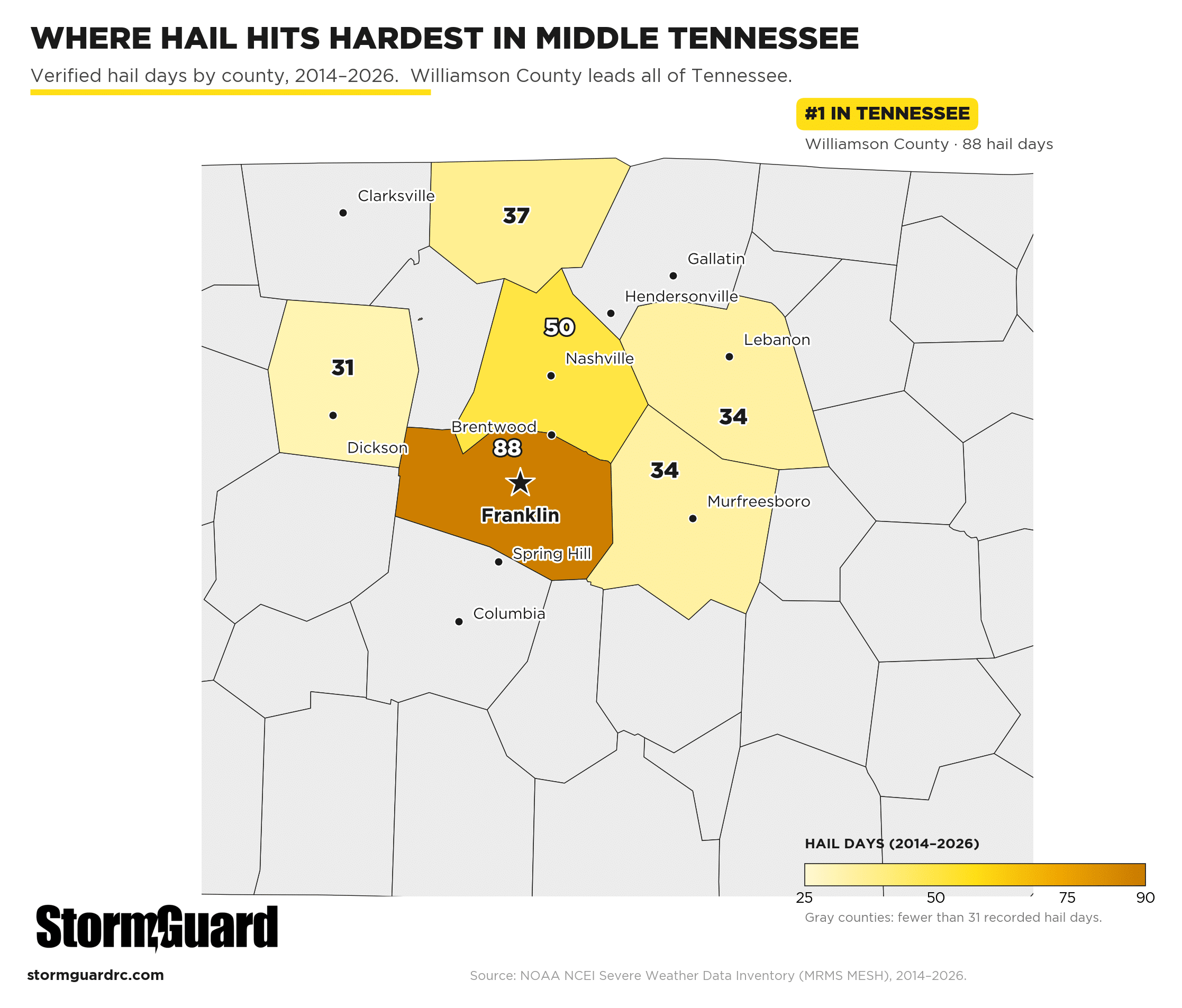
Here are the Middle Tennessee counties with the most recorded hail days:
| County | Hail days (2014-2026) | Key cities |
|---|---|---|
| Williamson | 88 | Franklin, Brentwood, Spring Hill |
| Davidson | 50 | Nashville |
| Robertson | 37 | Springfield |
| Wilson | 34 | Lebanon, Mt. Juliet |
| Rutherford | 34 | Murfreesboro, Smyrna |
| Dickson | 31 | Dickson |
Williamson County’s 88 hail days put it first in the entire state, roughly 66 percent ahead of the next county. If you live in Franklin or the nearby suburbs, your roof simply sees more hail than almost anyone else in Tennessee.
Middle Tennessee sits in a part of the South where warm, moist Gulf air collides with cooler systems moving across the plateau, and that clash is what builds the strong spring and summer storms that drop hail. Statewide, hail peaks in July, with heavy activity from May through August (NOAA NCEI, via ExoVzn, retrieved 2026-11-07).
Williamson County has taken some memorable hits. In May 2025, hail from golf-ball to baseball size damaged cars and buildings across Williamson County (WKRN News 2, retrieved 2026-11-07). A year earlier, on May 26, 2024, a supercell dropped hail up to three inches wide near Leiper’s Fork, and the National Weather Service reported numerous damaged cars and roofs (National Weather Service Nashville, retrieved 2026-11-07). Hail that size cracks shingles and dents gutters in a single storm.
The takeaway for homeowners is simple. In this part of Tennessee, hail is not a once-a-decade surprise. It is a seasonal risk worth planning around, the same way you would plan around summer heat or winter ice.
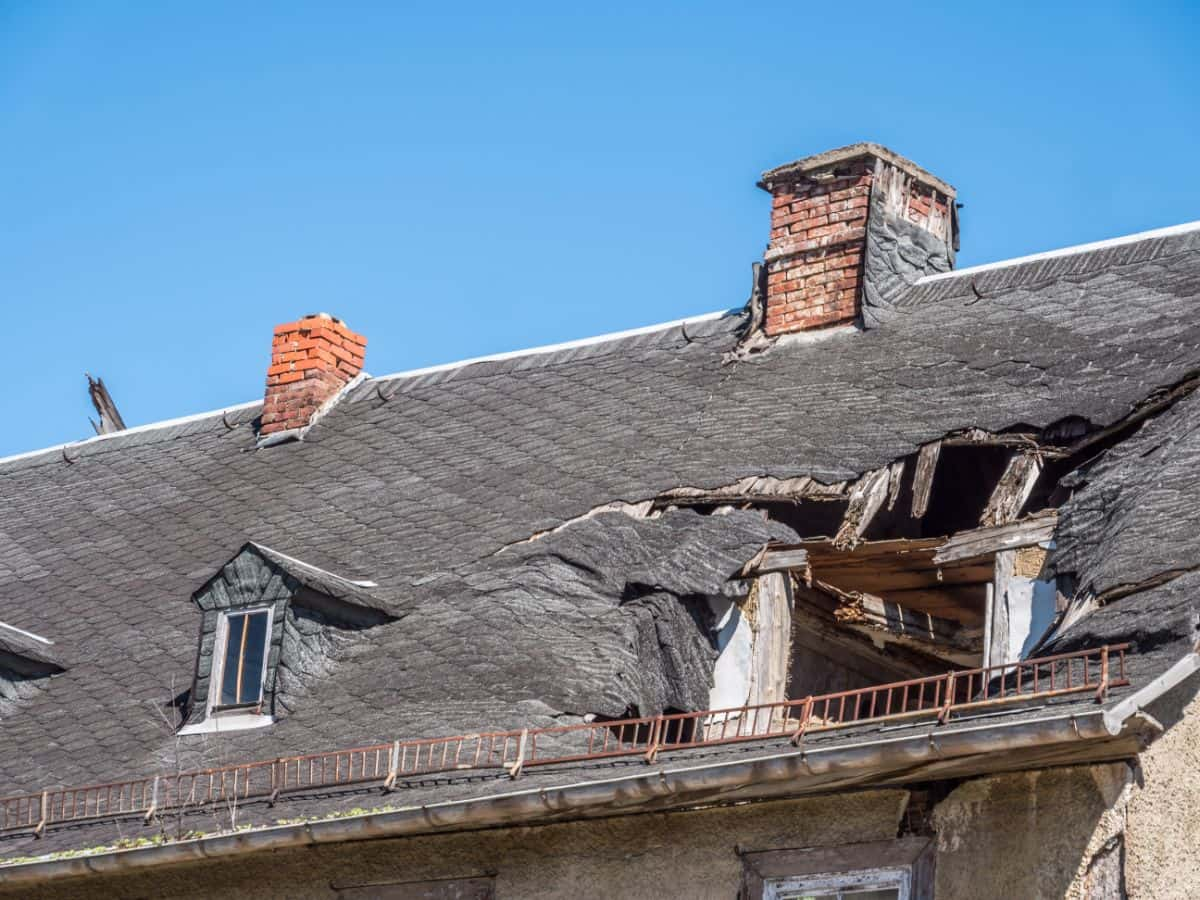
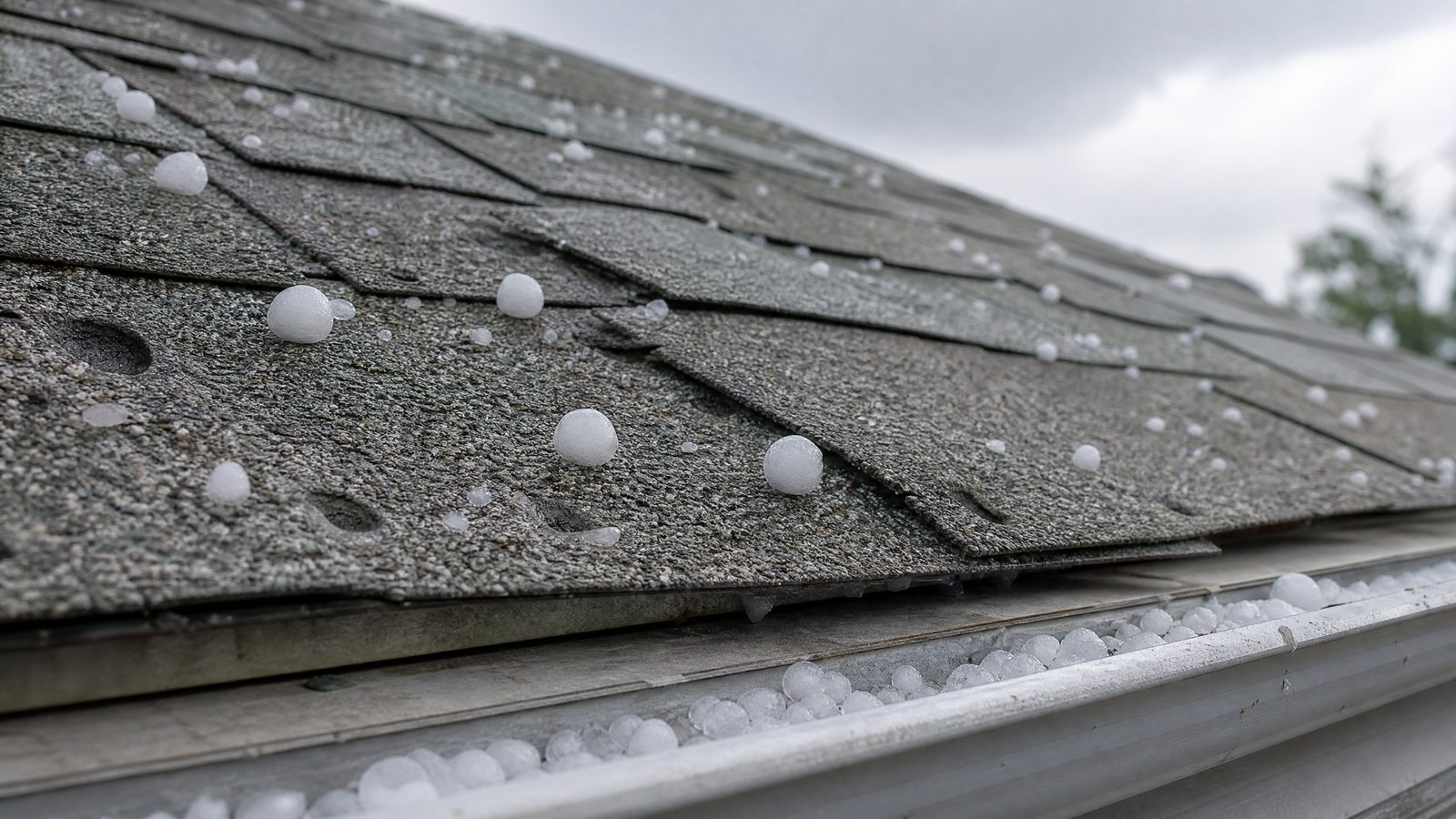
Most hail damage is not visible from your driveway, which is what makes it tricky. A hailstone strips away the protective granules on an asphalt shingle and bruises the mat underneath. The roof can look fine for weeks, then start leaking once that weakened spot gives way in the next rain.
A few signs are worth watching for after a storm:
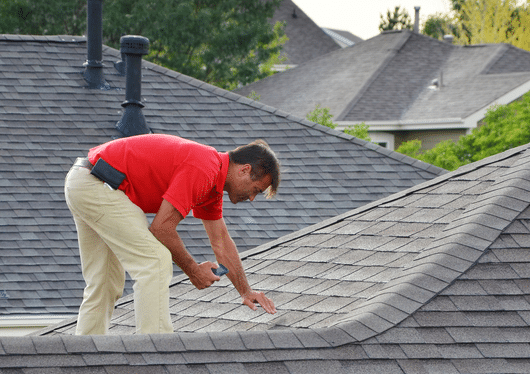
For a closer look at what to check, our guides on how to spot hail damage and how to know if hail has damaged your roof walk through it in detail. The safest approach, though, is to let a professional on the roof rather than climbing up yourself. Hail bruising is easy to miss from the ground and dangerous to chase on a ladder.
Act in order, and do not rush onto the roof. First, note the date and rough time of the storm, since your insurer and your roofer will both ask for it. Second, look around the yard for the easy ground-level signs above. Third, schedule a professional inspection so someone trained can check the parts you cannot safely see.
If the storm left your roof open or leaking, the first priority is keeping water out. A fast emergency roof tarp seals the breach until a full repair can be scheduled, and it limits the interior damage that drives up the final cost.
When you are ready for the inspection, a local roof inspection in Franklin gives you a clear, honest read on whether you are looking at a minor repair or something larger. A thorough inspector documents every hit with photos, which becomes the record you need if you decide to file an insurance claim.
Many homeowners policies cover hail damage, but whether yours does depends on your specific policy, your deductible, and your insurer’s assessment. Coverage is always your insurer’s decision. Here is how the process actually works, because there is a lot of confusing information out there.
You file and manage the claim with your insurance company. That part stays in your hands. A roofer’s job is to inspect your roof, document the damage thoroughly with photos and measurements, and give you a detailed written estimate you can share with your insurer. From there, your insurer reviews the claim and decides what is covered.
A few things to keep in mind:
For a step-by-step look at filing, our guide on navigating the claims process breaks it down. Be cautious with any contractor who offers to “handle your claim” or waive your deductible. Handling or negotiating your insurance claim is licensed work that belongs to you or a licensed public adjuster, not your roofer, and those offers are a red flag.
There is no single price, because cost depends on your roof’s size, pitch, material, and how much of it the hail actually damaged. A small, isolated repair can run from a few hundred to a couple thousand dollars. A full asphalt shingle replacement on an average Middle Tennessee home typically lands in the five figures, and premium materials like metal or synthetic slate cost more.
Rather than guess, the honest move is a free, itemized estimate after an inspection, so you see the real scope before you decide anything. For a general sense of what drives roof pricing, our average cost of a new roof breakdown is a useful starting point, and we always lay out financing options during the consultation.
If a storm has rolled through your part of Middle Tennessee, a local inspection is the clearest next step. Storm Guard is based in Franklin and works across the whole hail corridor, so the team already knows the damage patterns in each area:
A free inspection tells you where you stand, with no obligation. Schedule a consultation or call Storm Guard directly to get on the schedule.
Hail around one inch, roughly the size of a quarter, is the point where asphalt shingles start taking real damage, and that is also the National Weather Service severe threshold. Smaller hail can still wear an older or already-weakened roof. Softer surfaces like gutters and vents dent at smaller sizes.
Within a few weeks is ideal. Hail bruising often stays hidden until the shingle seal fails and a leak appears, so catching it early, while you still remember the storm date and before the next heavy rain, puts you in a much stronger position for both repairs and any insurance claim.
No, and that is the main trap. Most hail bruising is only clear up close on the roof itself. You might see dented gutters or granules in a downspout from the ground, but the shingle damage that leads to leaks usually needs a trained eye on the roof to find.
It can, but the age and condition of your roof may affect how the claim is handled, and coverage is always your insurer’s decision based on your specific policy. Thorough documentation of the storm damage, with dated photos and an inspection report, gives you the clearest case.
Middle Tennessee, and Williamson County in particular, sits at the center of some of the most frequent hail in the state. That is not a reason to worry, just a reason to stay ahead of it. Know the signs, get a professional inspection after a significant storm, and keep good records if you need to file a claim.
If a hailstorm has moved through your area, it helps to have a local roofer who knows Middle Tennessee storms take a look. Storm Guard is based in Franklin and inspects roofs across the hail corridor, so you get a clear, honest read on where your roof stands. Schedule a trusted consultation today or call (615) 988-9420. The right next step depends on your roof and your situation.
Sources




Unless otherwise noted, each use of "Storm Guard," “us,” “we,” or “our” throughout Stormguardrc.com collectively refers to both the Storm Guard brand and the Storm Guard Franchise System, which is made up almost exclusively of independently owned and operated franchise locations.